A little excursion: UEFA five year ranking system projected onto European basketball
The Euroleague and EuroCup qualification system has been a hot topic among European basketball followers for several years now. Most of the criticism had been directed at Jordi Bertomeu’s supposedly preferred treatment of the financially potent - big market Western countries such as Germany and France, and while this issue can certainly be discussed, the most striking weakness is the system’s, or whatever you want to call it, inconsistence and a lack of transparency.
Last week, I presented what the upcoming Euroleague season’s pool of participants will - according to our information - look like, and yes, even after finally understanding how it works, there are a lot of questions left, with “Which formulas were applied for the ranking system?” being only one of them. The installation of this mixture of ranking qualification system and direct qualification spots via multiyear licences just goes in line with what we had been experiencing the years before.
Those among us who follow European football as well have probably heard of the UEFA five year ranking system, which determines 1) how many starting slots the respective leagues receive for the international club competition, and 2) which teams get into the best drawing positions for the preliminary round and first group phase in the Champions League as well as the first rounds in the UEFA Cup. It is by many believed to be an objective - hence fair - system to rank leagues and clubs.
How about applying the UEFA ranking rules onto European basketball? ITG-reader Harbana came forward with this idea a few days ago, and all the credit should go to him for not only presenting me with the idea, but also doing the lion share of the work.
I. The league coefficient
In European football, the league coefficient has the function of ranking the domestic leagues in order to determine the number of teams each league is allowed to send to the international club competitions and/or its preliminary stages. There are points awarded for each win, draw, as well as bonus points for reaching several stages of the respective competition, plus a three point bonus for playing the Champions League regular season. It is a five year per team ranking. Projected onto European basketball, we awarded one point for a win, half a point for a draw [a rare case that is only to be seen in the two-game-knockout stages in EuroCup/former ULEB-Cup], 3 points for participating in the Euroleague, one point each for reaching a competition’s [goes for both Euroleague and EuroCup] quarter final, semifinal and final. The points of the respective countries’ participants are added and divided through the number of participants from that particular country - All that very similar to the UEFA ranking. We applied the numbers from [including] 03/04 to 07/08, as the 08/09 has yet to be finished. Be assured there will be an update come May.
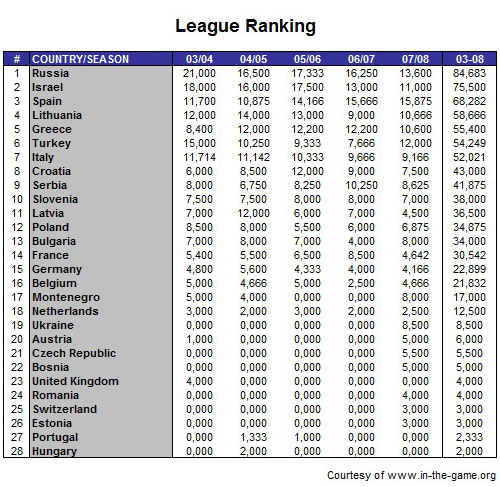
Quite a surprise at first glance, Russia and Israel are leading the rankings over the Spanish ACB, which of course is widely being regarded the best domestic league in Europe. The ranking is quite logical however. Take Israel for an example: Only the highly successful Maccabi Tel Aviv and Hapoel Jerusalem - which won the ULEB-Cup in 2004 - are regular participants, with Galil Elyon and Bnei Hasharon [this year, hence not yet included in the ranking] making guest appearances. As it is a per team ranking, Israel is way up in the rankings. However, if the ranking was in fact applied, it would have a way of self-regulation, meaning that it would probably apply four [maybe two plus two] or more spots to Israeli basketball teams next season - which would lead to a decline in per team production, as the [low-budget] Israeli teams apart from Maccabi Tel Aviv and Hapoel Jerusalem [even they're nowhere near the ULEB-Cup winning calibre team of 03/04] are not able to compete for top spots in international competition. Still, Israeli teams have been producing good results and the league would be among the Top10 for sure.
Russia is up there mainly because CSKA has been producing big time in the those five years [the number of Russian teams participating in European club competitions rose from one to five from 2003 to 2008, one additional team each year], but we cannot deny the fact that their teams have been winning a lot of games, even when there were five participants, such as in 07/08. What has often been missing is the big game victory, apart from Dynamo‘s ULEB-Cup winning season, and - of course - CSKA’s reign at the top of European basketball. If we applied four or five starting spots to Russian teams for the next years, a Top3/4 ranking position would be a realistic outlook. Again, they have excellent records in the group phases.
Lithuania is a similar case to Israel: Two spots most of the times, two strong ballclubs, but if we applied the five year ranking for a couple of years, it would probably self-regulate to three starting spots and find its place in the lower half of the Top10 in the ranking. And how about the rich kids, France and Germany? Down at 14 and 15, not justifying the number of spots they had been given in the past, but also a bit of a victim because of it. For example, the German BBL had five starting spots in the 07/08 ULEB-Cup, when they had and still have two teams at maximum that are able to compete in the group phases at that level.
To conclude, the league coefficient ranking is in this case flawed because of the irregularities in assigning spots in the past. However the flaws are obvious and explainable, and it looks like a system that is able to provide a balanced assigment system for European basketball club competitions. For this, of course the Euroleague modus and concrete assignment of spots would have to be [re-]discussed.
II. The club coefficient
The club coefficient formula provides a team ranking which is utilised by UEFA to assign teams to drawing pots [not the starting spots, those are exclusively determined by results in domestic competition] in Champions League and UEFA-Cup preminilary rounds and group phases. It is based on the same point system as described in the league coefficient sector, with the obvious difference being that it only produces numbers for each team, not for a country. The formula is: win points + bonus points + 1/3 of the team’s league coeffcient. The 1/3 of the league coefficient is added to a team even if it does not participate in international competition that year. At the same time, a 1/3 league coefficient can of course not be added when there is no team from the respective country participating that year, or simply if no team from that country wins a game in European club competition that year.
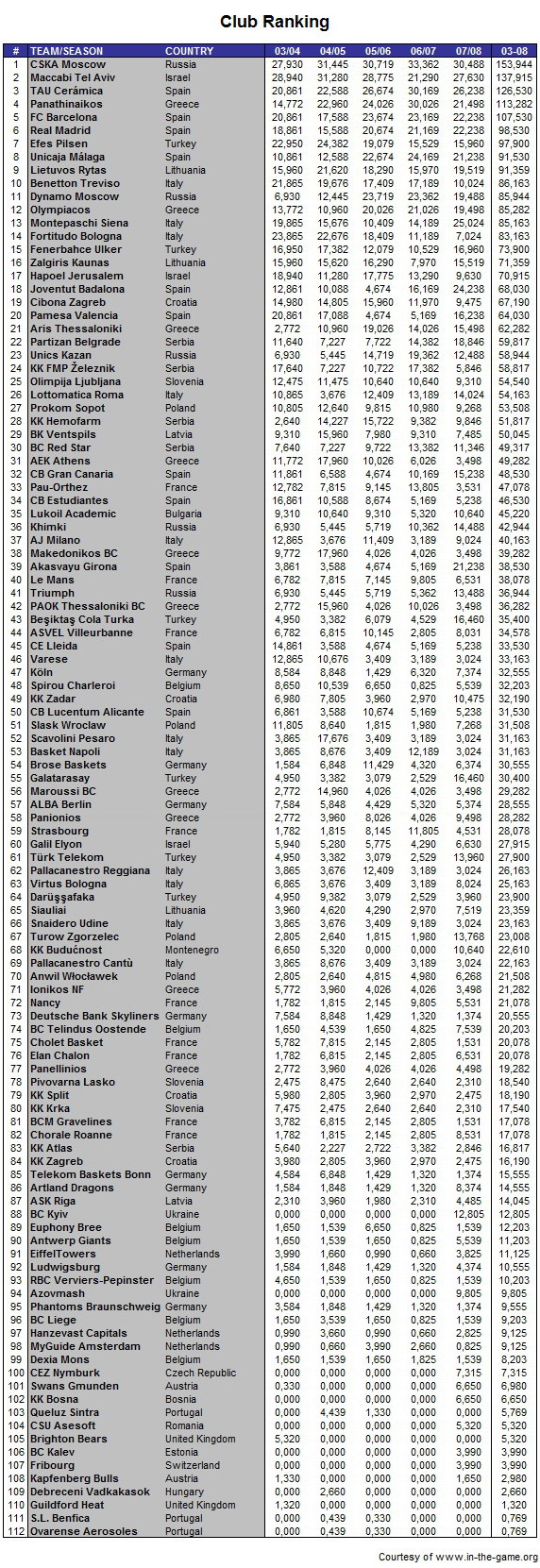
Another quite logical Top10 here, with regular Euroleague Final Four guests CSKA, Maccabi and TAU topping the rankings, followed by Panathinaikos and Spanish powerhouses, and rounded off by former Italian great Benetton and the in both competitions always producing Rytas. Add the 08/09 season, and Montepaschi will join the Top10 as well. Partizan‘s 22nd spot might seem a bit off at first glance considering the team’s heroics in the past few Euroleague seasons, but taking under account their rather average win-loss record in those seasons, it is no surprise at all. As the club coefficient is influenced by the league coefficient [on a sidenote, it is the league coefficient which gives CSKA the lead over Maccabi], it contains flaws as well, but the results do look reasonable.
As for importance for the system, the league coefficient is the bigger part obviously, however, the club coefficient is definitely worth taking a look at when comparing past successes in European club competitions. Remember that in UEFA the club coefficient does not rank the teams for each league’s starting places. Those are determined by who finishes on which place in the respective leagues. One does not need to be a genius to see that all of the big European clubs - we know that stability has been one of the main worries for them - would be regular Euroleague participants in the UEFA system as well.
Check here for a 08/09 update. Apart from the Euroleague Final Four which has yet to be played, all data for this season included.
Links: UEFA coefficients, 09/10 Euroleague participants - a short overview of what we know as of 2nd of Arpil 2009
Pingback: Dominance? at IN THE GAME